
Takeaways From 'Civic Friendship in a Polarized Age': How to Live and Interact in a Divided World
George Fox University's joint lecture by Cornel West and Robert P. George exemplifies how deep disagreement can coexist with genuine respect, friendship and shared purpose.
by Justus Ryan
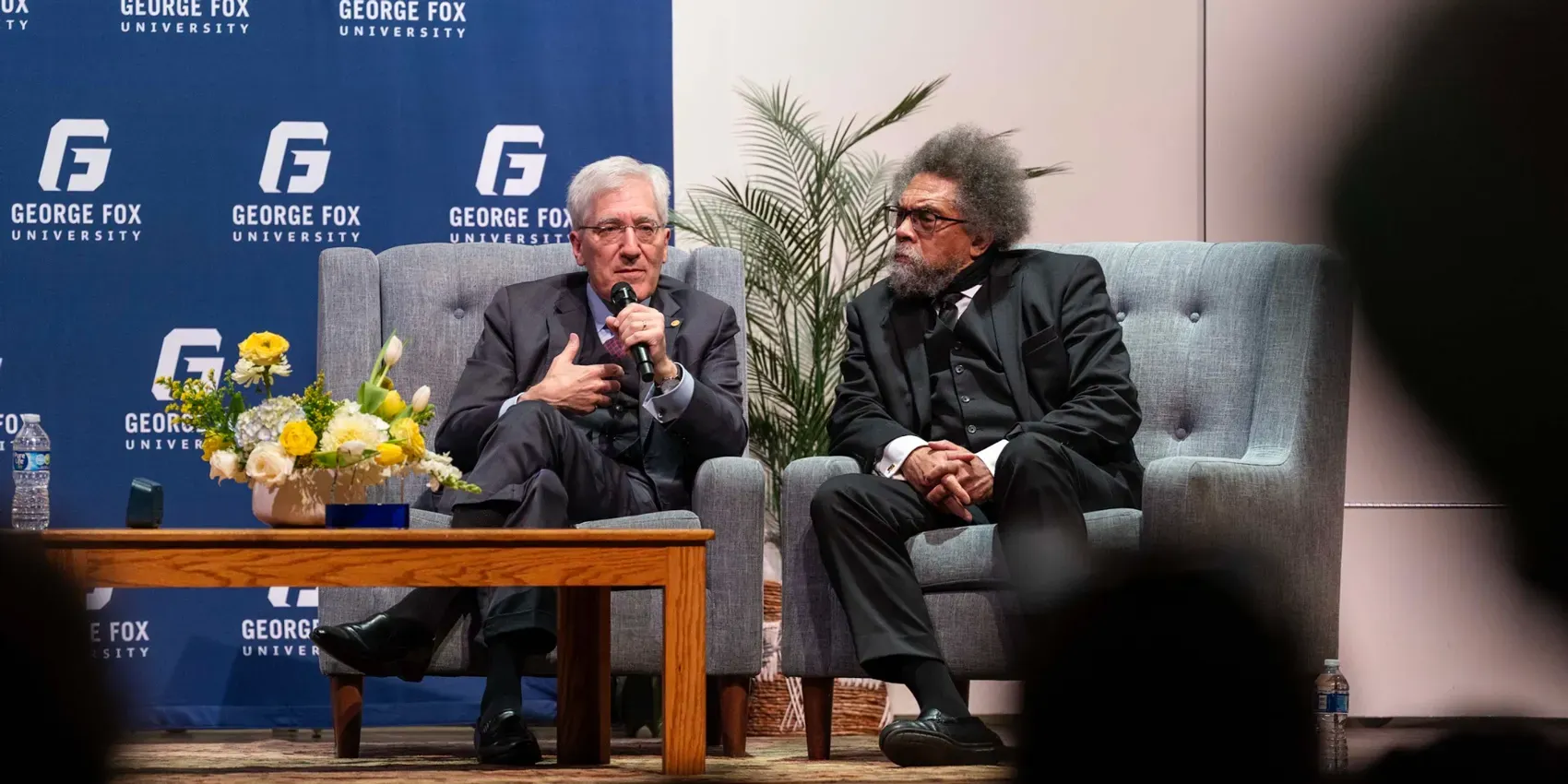
Attending the recent “Civic Friendship in a Polarized Age” lecture featuring Cornel West and Robert P. George at George Fox was one of the most impactful experiences I’ve had as a student. Going into the event, I expected a debate between two intellectuals with opposing views. Instead, what I witnessed was something much more meaningful: a model of how deep disagreement can coexist with genuine respect, friendship and shared purpose.
One of the central ideas of the lecture was the concept of “civic friendship.” Rather than treating disagreement as something that divides people permanently, both speakers emphasized that it can actually strengthen relationships when approached with humility and honesty.
A Model of Friendship Across the Divide
What stood out to me was that West and George are not just casual acquaintances; they are close friends who have worked together for years despite having fundamentally different political and philosophical beliefs. This challenged my own assumptions about what friendship looks like in today’s polarized world. As a student, I often feel pressure to align myself with certain viewpoints or communities, and it can feel risky to engage deeply with people who think differently. This lecture pushed me to reconsider that mindset.
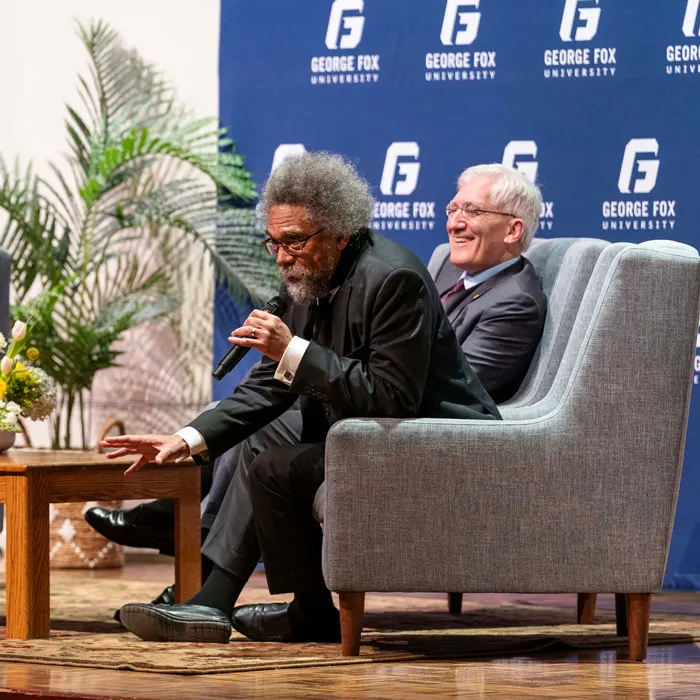
Dr. West’s emphasis on love, justice, and moral courage was especially powerful. He framed love not as something soft or passive, but as an active commitment to seeking truth and caring for others, even in the midst of conflict. His idea that justice is “what love looks like in public” made me reflect on how I engage with social issues.
It’s easy to argue or defend a position, but much harder to do so in a way that genuinely respects the dignity of others. As someone studying social work, this really resonated with me. It reminded me that advocacy should always be rooted in compassion, not just correctness.
On the other hand, Dr. George brought a strong emphasis on reason, truth and intellectual humility. He challenged the idea that feelings alone should guide our beliefs, arguing instead that truth requires careful thinking, dialogue, and a willingness to be wrong. This perspective balanced West’s more emotional and prophetic style, and together they demonstrated that both reason and empathy are necessary for meaningful conversations. As a student, I found this especially relevant in an academic setting, where discussions can sometimes become more about winning arguments than seeking truth.
What made their dialogue so compelling was not just what they said, but how they interacted with each other. There was a clear sense of mutual respect, even when they disagreed. They listened carefully, responded thoughtfully, and even used humor to keep the conversation engaging. It made me realize how rare that kind of interaction is, especially in today’s culture where conversations often turn into debates or arguments.
The event itself was described not as a debate, but as a demonstration of how to “disagree deeply and still remain friends.” Seeing that lived out in real time made the concept of civic friendship feel both tangible and achievable.
Another important takeaway for me was the idea of truth-seeking. Both speakers emphasized that individuals have a responsibility to pursue truth and to remain open to being challenged. This requires humility, the recognition that we might be wrong, and courage – the willingness to speak honestly even when it’s uncomfortable. As a college student, this hit close to home. It’s easy to stay within familiar perspectives or avoid difficult conversations, but growth requires stepping outside of that comfort zone. This lecture encouraged me to be more intentional about engaging with different viewpoints, not just to understand others, but to refine my own beliefs.
Carrying the Lesson into a Future Career
Personally, I also reflected on how this applies to my own life and relationships. Whether it’s in friendships, classroom discussions or future professional settings, the ability to maintain respect and connection across differences is incredibly important. In a helping profession, especially, I will encounter people from a wide range of backgrounds and belief systems. This lecture reminded me that my role is not to judge or dismiss those differences, but to engage with them thoughtfully and compassionately.
In conclusion, “Civic Friendship in a Polarized Age” was more than just an academic event, it was a powerful example of how to live and interact in a divided world. It challenged me to rethink how I approach disagreement, truth and relationships.
Most importantly, it showed me that it is possible to hold strong convictions while still valuing and respecting others. As a student, that is a lesson I will carry with me not only throughout my education, but into my future career and life beyond college.
Related Posts

Being Known, Mathematics, and Faith
Mathematics is a fantastic vehicle for understanding God. As we study and discover the order with which God has created the universe, as well as the rationality he has gifted us “image bearers” with, we are brought to even greater depths of awe and gratitude over his work and person. Thus, every class meeting is filled with the potential to worship Jesus more fully as we look into delightful aspects of his revelation to us.

A Community of Faith
At George Fox University, our Be Known Promise flows from our belief that you are known and loved by God. Our hope is that while you are here, you will experience the love of God, and engage in the vibrancy of our beautifully diverse community of Christ-followers.

The Advantages of Attending a Nonprofit College
Beyond looking at cost and convenience, prospective students should consider an institution’s educational goals, financial structure, governance model and outcomes data to help determine the best fit

How Chapel Is Reviving Faith at George Fox
The overwhelming response to our new chapel service is a testament to the deep hunger and thirst for Christ that so many students are bringing to our community.
The 4 Models of Christian College Education
What is a Christian institution, and why attend one?Recently, George Fox University President Robin Baker discussed the different approaches to education that schools take and the various philosophies around what it means to be a “Christian college.”
New Campus Chapel Offers a Tech-Free Haven for the Hurried Soul
Students and staff find a quiet refuge from the digital noise of academic life.